Ask a room of artists about stamp brushes and you'll start an argument. Purists call them cheating; working illustrators call them Tuesday. The truth is boring and useful: stamps are a foundation tool, and like every foundation, they're excellent when built upon and terrible when left showing.
What each tool type is actually for
Painting brushes leave a stroke: pencil, ink, paint. Your hand creates the mark entirely, direction, pressure, variation.
Stamp brushes leave a shape: one tap = a rendered form (a hairstyle silhouette, a figure pose, a leaf, a washi strip). One tap replaces anywhere from ten minutes to ten hours of construction.
They're not rivals; they operate at different workflow stages.
When stamps win
- Blocking complex anatomy. A female pose stamp or male pose stamp sets correct proportion and balance in one tap, then you redraw and stylize over it, so the final work is entirely yours but structurally sound.
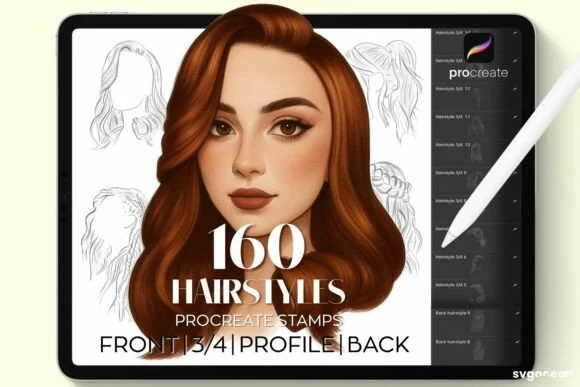
- Hair volume foundations. The biggest time sink in portraiture. A stamp from the Hair & Hairstyle Stamp Kit (160 stamps) gives instant, believable volume and flow; you paint strands and highlights on top.
- Repeating decorative elements. Patterns, scales, foliage, washi tapes, anywhere identical repetition is the goal rather than the problem.
- Layout & iteration speed. Ten silhouette-stamped concepts in five minutes beats one painstaking one.
When stamps hurt
- Left naked. An untouched stamp reads as a stamp to any trained eye. Always repaint: refine edges, vary the interior, push your own lines.
- Forcing composition. Stamps serve the composition, never the reverse. If you're bending your idea to fit a stamp, sketch instead.
- Same-size stamping. Scale stamps per use; repeated identical scale is the biggest tell.
The professional stamp workflow (paint-over method)
- Stamp on its own layer at target size, reduce opacity to 30–60%
- New layer above: redraw the key landmarks by hand, your style enters here
- Lower the stamp further or delete it; fill forms with painting brushes (a natural hair set for strand work, for example)
- Texture pass on top, visible blanket stamp texture dissolves into your own stroke language
The stamp is scaffolding. Nobody inspects scaffolding in the finished building.
FAQ
Is using stamps "real" art?
Commercial concept art, children's publishing and editorial illustration all use stamps daily at the highest professional level. Clients buy results and speed; only you see the process.
Will clients notice stamps?
Only if you skip the repaint pass. Foundations built over stamps are indistinguishable from scratch work because they *are* scratch work, with correct proportions underneath.
Can I modify a stamp brush?
Yes, open it in Procreate's Brush Studio, tweak spacing, jitter and falloff, and save a personal variant so your stamps stop looking like everyone's stamps.